Month: January 2015

No Excuses! A film about a transformation in Harlem – and the importance of quality PE

Tired of hearing excuses for why quality physical education is impossible when space is limited, class sizes large, students disinterested, and other reasons, we decided to do an “experiment”. We decided that if we could transform a “roll-out-the-ball gym class” approach in a school with plenty of barriers to quality physical education, we could honestly say that, “If you can teach quality P.E. here, you can do it anywhere!”
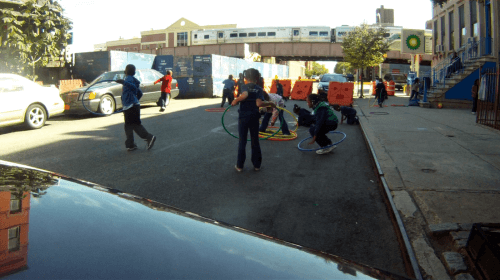
From the outset, we knew exactly which school to choose for our experiment. We had worked with the Storefront Academy in Harlem, New York before, and we knew that the school had teaching barriers that would be tough to overcome. They included a non-certified PE “teacher,” very limited indoor space, no playground areas, no free outdoor open space, and very little equipment. We decided to document the project in a film (directed by John Mathieu Roussell), and we called it No Excuses! We hoped that a film of this type would lead to increased awareness about quality physical education by parents and administrators, and to seeking solutions that focus on what we can do now, while continuing to work on changing the “impossible.” We wanted to help raise the bar so that all of us expect nothing less than quality in PE, for the sake of our students’ health, well-being, and academic success.

In the winter of 2011 we began working with the teachers and administrators at the Storefront Academy to retire the old ways of offering physical education and to develop a quality physical education program that fit the students’ current and future needs. We successfully sought out and obtained major support from SPARK (equipment, curriculum, technology, training), and hired a qualified credentialed physical education teacher for the next school year. At the end of summer, the teachers and most of the staff participated in SPARK training. We (Cathrine Himberg and John Roussell) spent our sabbatical that autumn in New York helping to implement the new program and documenting the process in our film. In Harlem, a coordinated school wellness initiative was in the making, with quality physical education at the center. Students started learning skills, concepts, and virtues in physical education chosen to help them now and throughout their lives. We made it safer and easier for them to choose to be physically active during recess on the blocked-off street that serves as their playground. We helped the teachers facilitate physical activity in the classrooms in the form of brain breaks. We made improvements in the cafeteria and encouraged nutrition education in the classroom. And we educated the parents about the changes and the important role they could play.
Values SHAPE America

First, let me introduce myself and justify why I might have anything worthwhile to say to the SHAPE America audience. Many years have passed since I was a teaching fellow at the University of Oregon in the same doctoral studies program as SHAPE America President, Steve Jefferies. For much of that time I’ve been ensconced in a liberal arts university, living the life of the university professor; happily teaching in the classroom, somewhat reluctantly serving in the college administration, and producing books with such esoteric titles as Contemporary Kinesiology and Health Ethics.

But it’s also true that in my dim and distant past, I received my teaching certification and experienced the life of teaching physical education. Given my world and worldview as a young teacher/coach back in the seventies in a comprehensive school in Oxfordshire, England, I’ve no doubt that public school PE teaching in the fast-paced world of contemporary America is very different. But I also suspect that some of the challenges and basic questions that I faced then and there are similar to issues you are encountering here and now. Similarly, although I have spent many years studying sport theory, I have also experienced the blood, sweat, and tears of coaching, both as the tennis coach at Wellesley College in the seventies and as the coach of the Women’s Soccer program at the College of William and Mary in the eighties. My point is that I have toiled in the trenches teaching students various physical activities and have had many years to reflect upon those experiences. So I was pleased when Steve asked me to share some thoughts and I’m hopeful that I can say something worthwhile to help shape SHAPE America.

Let’s take a journey (Destination: 50 million strong)
In his speech as candidate for President-Elect at the 2014 AAHPERD/SHAPE America Convention in St. Louis, Steve Jefferies suggested we should use the superb delivery system of a physical education teacher in every school to help us reach the goal of making “50 million strong,” meaning ensuring that the approximately 50 million young people in our schools are physically active and leading healthy lives. He identified a key ingredient to success in this venture as “a clear and unifying goal to strive for.” Because I share Steve’s concern for the future and have studied values intensively and extensively throughout my career, I plan to make this focus on a clear and unifying goal that we should strive for, the centerpiece of my essay.

Exploring the Future of Physical Education

One of the great things about technology is how its created more ways for us to communicate with each other. Face-to-face meetings may be more effective and enjoyable, but for many reasons we unfortunately can’t always get together at the same time and place. So this month, I’m pleased to be able to share with you a free online presentation that you might find interesting.

Time differences of course make it hard to join many presentations live. Fortunately, GOPHER Sport has recorded and archived its free monthly webinars online. It’s been doing this for more than a year. Take a look. I think you’ll be impressed by the topics and presenters – http://www.gophersport.com/webinar-recordings.

My recent presentation focused on where I think physical education should be going in the future. Since my participation in NASPE’s PE 2020 initiative a few years ago, I’ve become very interested in the future and especially in what it may hold for physical education.

What are Your 2015 PE Resolutions?

I’ve found that the best way to make New Year plans and resolutions is to think back to my last year’s resolutions. Did I stick with my resolutions or somehow seem to forget them? I start my asking my wife who is a retired principal a simple question, “Is there something you suggest for all teachers?”  Typically, she responds with the suggestion to ponder the question, “What will your students remember after they leave your school and graduate?” My wife isn’t a PE person, but she has guided me in many decisions by sharing her administrative perspective. One resolution that I used for many years was don’t tell me what you do, but show me results. Not games, nor gimmicks. Just prove to me what you do and show me the evidence.

Health and PE teachers hold the key to student success. Students should know about their body and how to take care of it, and as health or PE teachers we can help them with this. This includes using heart rate monitors, prescribing fitness regimens, teaching nutrition and doing all that we can to help our students stay healthy for a lifetime. Our role is to guide them on the path of discovery to making healthy choices, staying active, choosing to join gyms, and participating in their communities as citizens of the world. Through their behaviors our students should display an important message to the health care system.

Today, more than ever before, we can help fight the obesity dilemma and show the value of physical education. It’s our time to step on the soapbox and pound the steps of state legislators and show others what we as physical educators can do. My personal resolution is to continue to remain as an advocate for all we do as physical education teachers and explore all possible avenues to garner support. And we need to go beyond recognizing the hundreds of awesome teachers on Facebook and thousands of top notch teachers across the country: It is our job to help change the behaviors of those teachers who don’t understand what quality PE is, and others who are either lazy or don’t care.

In 2015, Let’s Track our Progress!

How many of you are planning to set New Year’s Resolutions this year?

  • Are you serious about setting them?
  • Are you serious about keeping them?
  • Are you serious about maintaining them after you reach them?

Physical Education New Year Resolutions

Usually teachers think about fresh ideas before the school year begins, but since this is New Year’s Resolution time, rethinking and re-evaluation is in order. After all, it’s always good to reflect how well you are meeting the professional goals you set for the current school year.

I always wanted to get my kids participating in heart pumping physical activity for most of their class time while doing something they might feel motivated to do on their own when not in school. I was determined to give each student a chance to participate fully, during the course of the school year – in as many physical education units that they LOVED or at the very least, that they would value for its health benefits.

Unless you’ve known your students for years this is difficult to evaluate midstream, but by this time in the school year you should be able to identify the students who are in need of something different in order to get their heart and head involved in physical education. That’s why the start of the New Year is a great time to ask yourself whether you are meeting the needs of all of your students. These include those who are:

Healthy New Year Resolutions

Years ago I stopped making New Year’s resolutions. They became pointless, depressing when unachieved, and as statistics show, nearly all the resolutions made (1 in 3 people apparently resolve to change something), about 75% of them last only one week! Six months into the resolution about 46% are still on target. That number continually declines as times goes on. That’s not to say that resolutions should never be made. Rather we should be more realistic in what it is exactly that we want to change or improve upon. We all know the old mainstays…. try to lose weight, quit smoking, volunteer more time, get in shape, save money, etc. But how about some work related resolutions? I came across some very inspirational articles in the PELinks4U January 2011 archives (Steve Jefferies and Sam Baumgarten, Kleinman, and Amy Sue Hesselgesser). Many good ideas were stressed in all those articles so I will try not to be too repetitive. Here’s my personal list:

  1. Pay more attention to those students who are under the radar
    The kids who are not the athletes are the ones who are probably going to be running our schools and districts in the future. We need to make them feel good about themselves because the fact is, THEY ARE THE MAJORITY. Each day I try to focus on a student I really don’t know or who is so quiet and on the periphery that he or she easily gets lost in the crowd. Some days are so busy and hectic I forget to make a connection. But that doesn’t mean that the resolution ends! Tomorrow is another day and I try again.

  1. Keep yourself fit as a positive role model
    Yes, this is a traditional resolution but for years I’ve been promising myself to join a gym. I believe I’m in “role model” shape but this was about something more intrinsic. Plus, I’d really like to be able to climb the rope a bit higher when I do my demonstration during our “Tumbling/Climbing Unit!” The kids love it when you can do things and share your own story. They can relate better to your own struggles and goals when they’re struggling themselves. It lets them know that even though they may not be able to perform a task today, someday they will succeed if they set their minds to it.
  2. Learn to use a new piece of technology & incorporate it into your lessons
    I used to love technology but it changes so fast now that it’s tempting to simply choose not to keep up. Yes, I have an I-pad (generously donated to me by my sister) but my IPod is a “classic” and my cell phone is a “pay as you go” flip phone. I have played around with some apps and have used Team Shake to make teams in class. I love this app because I like to separate “friends” and when they complain that they’re not on the same team I say, “It’s the computer!” If my district were more liberal with the use of the Wi-Fi code then I would probably use it more but at this point in time I’m fairly limited. I guess this is an item to put on my list for next year. It’s a big-ticket item to get the access complete with a Smart Board so I’m going to file that one away for a future date.
  3. Conduct surveys with your students AND parents
    Surveys are the most underused means of gathering information to improve your program. I think that maybe people are just too afraid of what they’re going to find out. I conducted one last spring and the results were not as harsh as I had expected. In fact, the results were very positive with only a few concerns about a child’s weight and perhaps the fact that our school does not meet the state mandate for time spent in physical education class. Most felt that fitness, social emotional learning, and character education were the most important things their child could learn in my class. This survey encourages me to keep doing what I’m doing, which was nice to know.
  4. Clean out your office and equipment closet!
    I am the “Queen of Keeping” and my colleagues make fun of me. I have documents that I inherited nearly 20 years ago from my predecessor along with records, cassette tapes, floppy discs and lots of broken or deflated equipment. I guess you could say that I’m from the era of “You Never Know When You Can Use It!” Starting at the beginning of this year I started filling the garbage bags and confess that at times it was painful. But as painful as it was, it felt good when it was gone! Now I have less clutter and even discovered a few “new” items that I had hidden away. Two of my favorite books are Junkyard Sports (B. DeKoven) and Creative Physical Activities & Equipment (B. Davison) both from Human Kinetics. I also held onto a few of my deflated basketballs – they work great for passing only activities!
  1. Go through old files and rediscover those great games/activities that you’ve saved
    After you’ve been to a gazillion professional conferences and workshops you tend to “file away” tons of information and then forget to look at it all. Every so often I make it a point to go through all those files and start using those great activities that I thought were so terrific once upon a time. I’ve discovered that what is a good activity for one unit can sometimes be modified and used in another.
  2. Take control of your program!
    I don’t know about you but I’m getting a little tired of the expectation that I’m supposed to incorporate ELA (English Language Arts) or Math or some other “Core” subject into my daily lessons. The fact of the matter is I do try to integrate but it’s in line with Physical Education and Physical Literacy, not as a separate academic subject for which I have not been trained. We need to educate our administrators and make them aware of what our discipline is about and what students learn in our environment. The brain and body connection is so important but my students don’t need paper and pens or pencils to prove it. Don’t get me wrong, learning through movement is a great opportunity and lots can be taught with an interdisciplinary approach but that’s not my job description.
  3. Get at least 1 colleague to join SHAPE America and/or your local State AHPERD
    I’m on the Board of my local state AHPERD Zone and have a passion for professionalism. Not everyone agrees about the importance of supporting our organizations and the excuses of why not to join are varied and endless. If you can get just one person to sign up, that makes us one person stronger! Out of 42 physical education and health teachers in my own district, only 5 are current members of our State AHPERD. I think I’m the only one who belongs to SHAPE America as well. I’m working on 4 more, a bit ambitious but I’m starting with those whose memberships have lapsed and they just need a nudge (or several!) to rejoin.