Title IX, federal legislation passed in 1972, prohibits discrimination based on sex in education programs that receive federal money (Acosta & Carpenter, 2014, p. 5). Since the law’s inception, girls’ and womens’ participation in sports has increased annually. Today, more females are participating in sports then ever before. In comparison, a notable decline in female coaches has occurred (LaVoi, 2013). In 1972, [approximately] 9 out of 10 coaches for women’s teams were female (Acosta & Carpenter, 2014, p. 10). In 2014, the number has dropped to approximately 4 out of 10. In addition, only approximately 3% of coaches of men’s teams are women (Acosta & Carpenter, 2014).
“Sport is inextricably linked to the American ideal of meritocracy that if you are good enough, work hard enough, and make sacrifices, you will have the opportunity to achieve and succeed. Although this ideology has prevailed for athletes, does this same ideal of meritocracy apply to the coaching profession? Does it apply to all coaches both male and female?” (LaVoi, 2013, p. 1).
It has long been thought that playing experience determined coaching opportunities. But with more girls and women playing then ever before, and yet declining numbers of women in coaching, this long held belief is today being challenged. Interpretation of the data as to why women are not coaching may relate to economic biases, social myths, or personal reasons (Stoll & Van Mullem, 2010, p. 7).
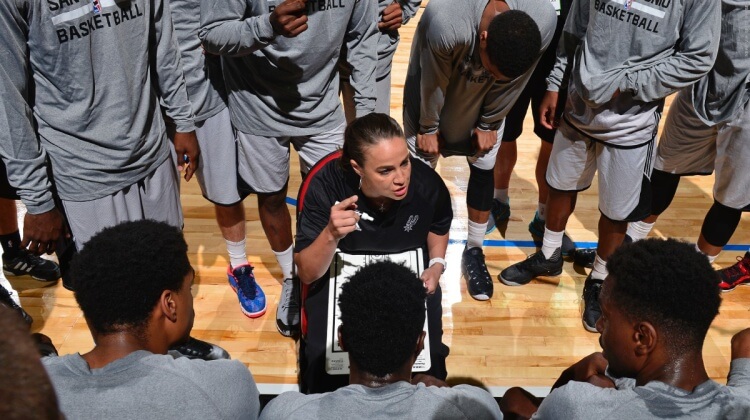
Trailblazer, pioneer — words we use to describe a person who paves the way for new opportunities for others. Becky Hammon is a trailblazer and a pioneer. A 16-year veteran in the Women’s National Basketball Association (WNBA), Hammon spent 8 years with the New York Liberty and 8 years with the San Antonio Stars (Voepel, n.d.). A decorated athlete, she was a seven-time WNBA All-Star, two-time All-WNBA First Team honoree and three-time NCAA All-American [at Colorado State University] (Voepel, n.d).


 Today, Native American athletes continue to play and succeed in sports although their efforts are seldom recognized. Unfortunately, “athletic skills developed on American Indian land are often contained within its boundaries” (Selena, 2001, p. 1). What little media coverage Native American female athletes have received, has tended to focus on failures rather than highlight successes. With the absence of their stories and thus their voice, the media has perpetuated the belief that if Native American female athletes do exist, they must struggle to be successful. Unfortunately, this practice of primarily recognizing the negative stories, or providing no stories at all, has served to reinforce incorrect stereotypes that Native American female student-athletes are not or cannot be successful in mainstream sports (King, 2005).