Category: PHE Current Issues

This category includes essays and articles on a wide range of topics. Read what’s good and what the challenges are about current teaching and coaching practices, and what physical and health education must do to thrive in the future. It’s a place to share, discuss, and debate ideas. Read and join the conversation.

What’s Your Number?

(This essay was originally published on SHAPE America’s member Exchange [June, 2015] and is reprinted with permission.)

Some time ago, Kevin Costner starred in a movie called “The Guardian.” He played Ben Randall a legendary Coast Guard rescue swimmer admired for his success saving lives. A new recruit, determined to better Randall’s achievements, repeatedly asks him for his “number.” How many lives has he saved? Randall avoids responding, until close to the movie’s end when, pressed again for his number, he responds, “Twenty-two.” The rookie life saver is surprised because it is a rather unimpressive number for a legend. But then Randall explains, “Twenty-two is the number of lives I failed to save!”
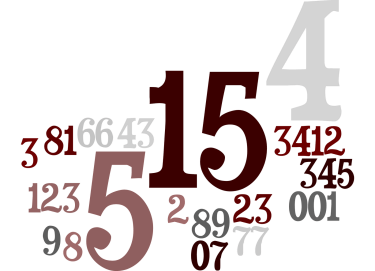
Jim Perry, familiar to many of you as one of SHAPE America’s longtime sport advocates, reminded me of this story after my recent presentation at the Southwest District/Utah AHPERD conference in Park City. He’d listened to me talk about “50 Million Strong by 2029,” SHAPE America’s goal to get all kids entering preschool this fall physically active and healthy in 14 years (or sooner). At the end of the session, audience members began personalizing the challenge. They described their unique piece in the puzzle. As K-12 health and physical educators they were responsible for two, three, or four hundred kids. The numbers varied by level but the point was clear. The way to reach 50 million is for each of us to focus on what we can do. None of us can change the behaviors of millions, but each one of us can take responsibility for changing the physical activity and health habits of all of the students we serve in our schools.  After listening to this exchange, it was Jim who in his usual quiet and deliberative manner suggested that each of us should focus on answering the question, “What’s my number?”

Living a Life that Matters: Invest in Others’ Success

Michael Josephson, founder and director of the Josephson Institute, wrote a poem entitled, “What Will Matter.” In it he asks his readers to “live a life that matters” (Josephson, 2003). He describes this lifestyle as a choice:

…What will matter is not what you bought but what you built, not what you got but what you gave. What will matter is not your success but your significance. What will matter is not what you learned but what you taught. What will matter is every act of integrity, compassion, courage, or sacrifice that enriched, empowered or encouraged others to emulate your example. What will matter is not how many people you knew, but how many will feel a lasting loss when you’re gone. What will matter is not your memories but the memories that live in those who loved you. What will matter is how long you will be remembered, by whom and for what (Josephson, 2003).

As teachers and coaches, we are presented with opportunities every day to invest in the growth and success of others. Opportunities to share our love for the content we teach or the activity we coach are plentiful. The environments we create for the sharing and construction of knowledge and learning are crucial to the positive growth of those we have the opportunity to work with. The conscious investment in others ultimately provides the opportunity for them to also “pay it forward.”

Want Smarter, Healthier Kids? Try Physical Education!

Paul Zientarski has dedicated much of his life to getting people to think differently about the value of physical education. He was responsible for developing the hugely successful PE program in Naperville IL, and today continues to share his passion for physical education through a TEDx Talk.

Watch the video and be inspired.

Creating Positive Values Through the Promotion of Physical Activity Education

Few others have been as influential on the field of physical education than Earle Zeigler. A prolific author and presenter, Earle has challenged professional thinking for more than 70 years. Now aged 96, Earle shares this thoughts and continues to suggest what our profession needs to do in order to secure its future.

Click on the link below to download the Word file with Earl’s essay.

Zeigler_Creating_Positive_Values_4

Health and Physical Education the Super Pill?

Among this month’s pelinks4u articles is a summary of research by David Kahan and Thom McKenzie in which they address the potential value of effectively delivered physical education on children’s overweight and obesity. It’s an interesting read and shows clearly the caloric impact of getting students physically active in PE classes. Given the nationwide alarm about the catastrophic consequences of overweight and obesity on future generations, it’s yet another reason for the public to support public school physical education.

But, as I’ve written before, simply justifying health and physical education only because of its potential to turn back the obesity tide, shortchanges our subject areas. We are much more than an obesity solution. Well planned and delivered school health and physical education enhances pretty much everything that’s important in the upbringing and preparation of children for future success in life.

In another of this month’s articles, Tom Winiecki a 30-year veteran elementary PE teacher, points out that his focus is not primarily on delivering our subject matter but on connecting with his students. This reinforces another critical idea essential to helping students succeed in our schools. Teachers need to connect with kids “where they’re at.” In other words, before even concerning ourselves with content we need to first and foremost develop the kind of positive relationships with our students that help them see the relevance in what we’re teaching. Unless students see relevance it really doesn’t much matter what we teach. They aren’t going to value it. And absent value, students simply aren’t going to learn much from us.

University of Northern Colorado Unveils a New Online Master’s Program to Prepare Leaders of School-Wide Physical Activity

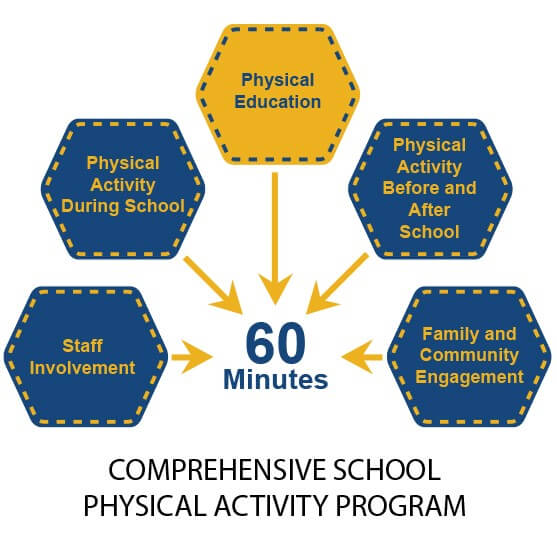
Schools have been charged to take a whole-of-school approach to promote daily physical activity participation among school-aged youth. A comprehensive school physical activity program (CSPAP) is a guiding model (see figure) for the provision of daily opportunities for students to accumulate 60 minutes or more of physical activity across five components: a) quality physical education, b) physical activity during school, c) physical activity before/after school, d) staff involvement, and e) family/community engagement. Many CSPAP resources, tools and training materials are available through Let’s Move! Active Schools (www.letsmoveschools.org) to support school professionals in leading CSPAP efforts. Learning experiences are now also being offered within university curricula to help prepare the next generation of school professionals for their role as leaders and supporters of school-wide physical activity promotion.

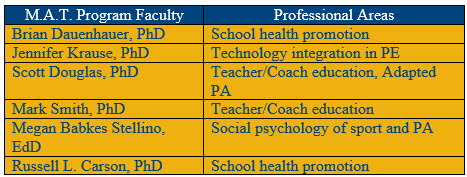
The Sport and Exercise Science faculty (see table) at the University of Northern Colorado (UNC) have answered the call for CSPAP-enhanced teacher preparation programs by reshaping their Master of Arts in Teaching (M.A.T.) program. The M.A.T in Physical Education and Physical Activity Leadership at UNC is one of the first of its kind dedicated to preparing, supporting, and mentoring school champions to effectively implement prolonged CSPAP efforts in and around schools. The two year program is conducted in a convenient hybrid format for working professionals; online courses occur during the fall and spring semesters, and an on-campus two-week summer institute during the summer. The program advances candidates’ knowledge in physical education, while educating them on how to promote school-wide physical activity, coordinate before and after school physical activity opportunities, and increase staff, family, and community involvement. Applications for the first cohort are now being accepted at www.UNCActiveSchools.com. Physical educators, classroom teachers, and district or school administrators are encouraged to apply. Summer travel scholarships ($1,500 each) are available to nearly all accepted candidates.

Student Perspectives: