Category: PHE Current Issues

This category includes essays and articles on a wide range of topics. Read what’s good and what the challenges are about current teaching and coaching practices, and what physical and health education must do to thrive in the future. It’s a place to share, discuss, and debate ideas. Read and join the conversation.

Physical Education is all about Improving Lives

“Where is your passion?” I recently asked this of a group of physical education undergraduates who were halfway through their student teaching. In putting together my presentation to them, I wanted something that would grab their attention right away and get them thinking about their chosen profession. I think this question did the trick.

When I asked for their answers, I got many of the response I anticipated. Most of them said something along the lines of “physical activity,” or “physical fitness,” or even “teaching kids about sports and fitness.” But then one of these students gave me the answer I was hoping for. His answer was “to teach kids.” When I pressed him to tell me more, low I thought he would say something PE related. I was both surprised and impressed when he answered by saying “anything!” That was the answer I was hoping for and what I wanted to get all of the students to think about.

You see I believe that there is a big difference between our passion and our expertise. Our passion needs to be kids. First and foremost our main focus should be on the kids we are fortunate enough to see daily (even the ones that seem to go the extra mile to make our jobs difficult). We are there to create an environment where our students can thrive. As basic as that sounds I believe this should be our main focus.

Our expertise is in the subject we teach. For us and for those undergraduates it is physical education. Physical educators spend their entire careers honing this expertise. Many of us have taught for years, regularly reviewed our lessons and constantly made necessary adjustments. We’ve attended countless conferences to learn how to expand our expertise. We’ve picked the brains of colleagues always looking for a better way to teach something. But none of this is any good unless it’s aimed at our passion: Helping to improve the lives of the kids we see daily!

The Geometric Shape of Physical Education

I just returned from a successful weekend road trip. I say successful because of the 5 hours that I personally drove; I only missed one exit, resulting in a short 10-minute detour from our destination. For those of you who know me this is a huge accomplishment. In recent years, I rarely make it to a destination without multiple U-turns. The worst was when my husband woke from a nap in the passenger’s seat to find that I had traveled three quarters of the way around the Washington D.C. loop and was heading back north on our trip from New York to North Carolina! I emphatically insist that if the co-pilot stayed awake during the entire trip these things wouldn’t happen. But the truth is that once I get on the highway and point my wheels between the dotted white lines, the driver in me goes on autopilot and my mind travels elsewhere toward solving the problems of the world.

Okay, maybe I am exaggerating. Truthfully, I could be thinking about grocery shopping, my next bulletin board, or our new puppy, but over the last 2 years I have also had a recurring philosophical debate with myself – “What geometric shape best represents physical education in today’s society?”

This internal discussion began after reading Knowledge/Skills and Physical Activity: Two Different Coins, or Two Sides of the Same Coin? (Blankenship, 2013). In it, Bonnie questions the direction of physical education. She refers to physical education and physical activity as being two sides of the same coin. The image of physical education as a coin with two sides got me thinking about my beloved Springfield College Triangle and the Humanics Philosophy.

The Promise and Reality of Physical Education in Controlling Overweight and Obesity

Physical Education (PE) has great potential for helping to control overweight-but only if it is implemented AND actually engages students in ample amounts of physical activity. Unfortunately, very few states even report how many minutes of physical education are required in schools. PE is rarely scheduled daily and even when scheduled is often not held (about 20% of lessons are cancelled for various reasons-no substitute for PE teacher; gym not available; academic testing during PE time). When held as scheduled, actual PE length is only about 78% of the time scheduled for it. Clearly there is an obvious need for additional and more specific PE policies at many levels (state, district, school) together with consequences for not following them.

Meanwhile, the quality of PE is not uniformly optimal, and this got us thinking: If schools actually met the Society of Health and Physical Educator’s (SHAPE America) and the Institute of Medicine’s (IOM) recommendations for quality PE, how much could PE contribute to caloric expenditure and the potential for controlling for overweight and obesity?

Presently, we really don’t know much about this because we often talk in units (METs, % MVPA [moderate-to-vigorous physical activity]) that don’t translate well to students, parents, principals, school boards, and other stakeholders. Incorporating calories into the conversation may transform how PE is viewed. To start this question we needed data, and we did this in a recently published article, The Potential and Reality of Physical Education in Controlling Overweight and Obesity (Kahan & McKenzie, 2015).

Shelly Hoffman Teacher of the Year

“The kids are the future, we have to make sure we invest in the future…show them how important they all are.show them to be more than their upbringing.”- Shelly Hoffman

In 2014, Shelly Hoffman of Franklin Elementary School in Wichita, Kansas was recognized as SHAPE America’s National Elementary Physical Education Teacher of the Year (TOY). Shelly has been with her current school district for 26 years.

“I love teaching. I love seeing that light bulb turn on when the kids finally get it. That moment when they achieve it, that is what I love the most. I am the toughest teacher, but it’s because I love the kids and want to see them excel.”

Physical Education is all about Improving Lives

“Where is your passion?” I recently asked this of a group of physical education undergraduates who were halfway through their student teaching. In putting together my presentation to them, I wanted something that would grab their attention right away and get them thinking about their chosen profession. I think this question did the trick.

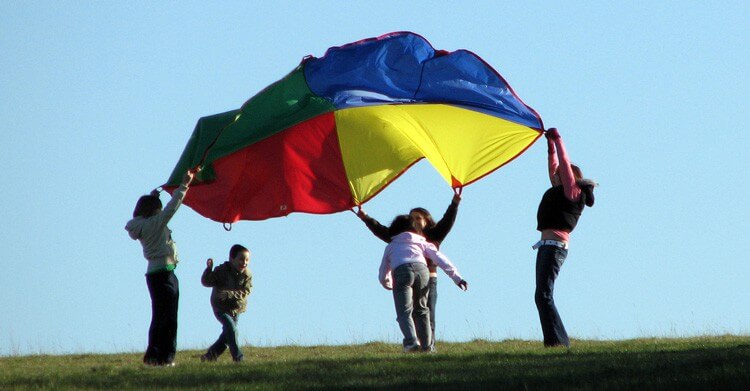
Kids Playing

When I asked for their answers, I got many of the response I anticipated. Most of them said something along the lines of “physical activity,” or “physical fitness,” or even “teaching kids about sports and fitness.” But then one of these students gave me the answer I was hoping for. His answer was “to teach kids.” When I pressed him to tell me more, low I thought he would say something PE related. I was both surprised and impressed when he answered by saying “anything!” That was the answer I was hoping for and what I wanted to get all of the students to think about.

You see I believe that there is a big difference between our passion and our expertise. Our passion needs to be kids. First and foremost our main focus should be on the kids we are fortunate enough to see daily (even the ones that seem to go the extra mile to make our jobs difficult). We are there to create an environment where our students can thrive. As basic as that sounds I believe this should be our main focus.

Art, Music, and Physical Education

Note: Reprinted from the Ahwatukee Foothills News, March 17, 2015, reprinted by permission.

Over the last few months, much has been written about funding for Arizona education. The seventeen percent decrease in funding in recent years and diversion of funds designated for education have prompted a variety of comments. Rarely mentioned, however, is the fact that art, music, and physical education programs have been dramatically cut as funding has decreased. Improving test scores in math and language arts seems to be the primary goal and “special” programs such as art, music, and physical education are the first to go when budget shortfalls occur. If and when funding is restored, these programs sometimes, referred to as “frills” are rarely restored.

But what does the evidence tell us about these “special programs?” It tells us that they really are special, not frills. Lets take a look at the evidence. Students who participate in the arts read more often, are four times more likely to do public service, four times more likely to be in a math or science fair, and three times more likely to bet elected to a class office than other students.

SHAPE America Announces 50 Million Strong by 2029

Congratulations!
Today is your day,
You’re off to Great Places!
You’re off and away!
You have brains in your head.
You have feet in your shoes
You can steer yourself
any direction you choose.
You’re on your own. And you know what you know.
And YOU are the guy who’ll decide where to go.

(Dr. Seuss, Oh, the Places You’ll Go!)

At the recent SHAPE America National Convention in Seattle, President Dolly Lambdin made a historical announcement. During Wednesday’s opening General Session following an opening message from First Lady Michelle Obama, Dolly informed the audience of SHAPE America’s new statement of purpose.

This fall, students starting preschool will graduate as seniors in 2029. SHAPE America is committing to ensuring every single student regardless of ability will by then be physically active and healthy. Clearly an ambitious and somewhat daunting goal, the 50 million strong by 2029 statement was reminiscent of President John Kennedy’s 1961 vision to put a man on the moon within a decade, and return him safely back to earth. And similar to Kennedy’s moonshot vision, SHAPE America plans to succeed.